

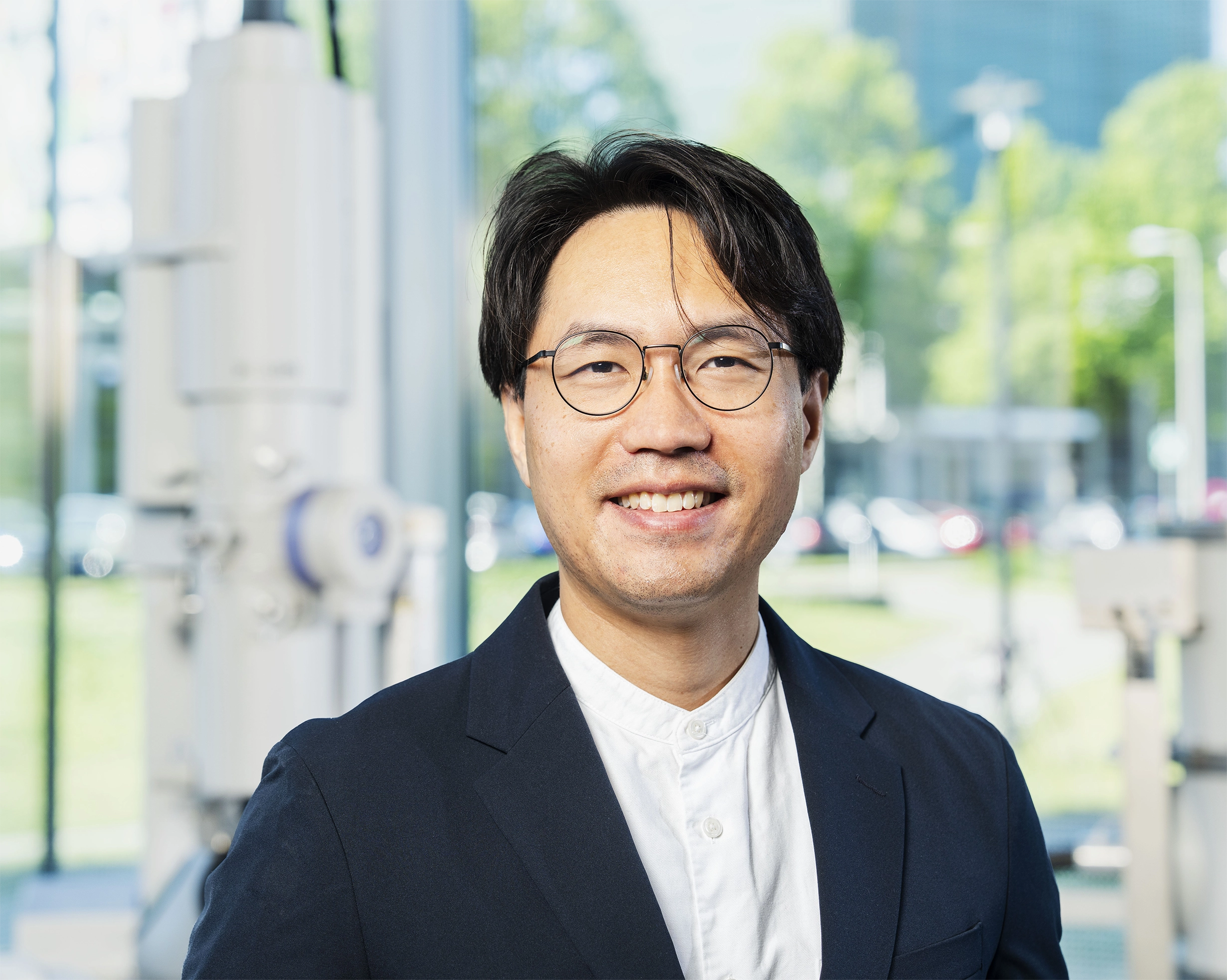
In many forms of infertility, it has been established that something is going wrong with sperm or egg cells, but exactly what remains unclear. Miguel Leung (1996) is trying to unravel that mystery by closely studying the molecules in these cells. As a structural biologist at the Hubrecht Institute, he combines cryo-electron microscopy with AI to visualise protein structures at a resolution that was previously inaccessible. For his research, he is receiving the Heineken Young Scientists Award for Medical/Biomedical Sciences 2026.
What becomes visible if you can zoom in far enough on the interior of a cell? Using cryo-electron microscopy and tomography, Miguel Leung is able to visualise protein complexes in very high resolution, in an almost natural state. When molecules are flash-frozen at incredible speed, they stay trapped in the form they had inside the cell. This allows him to capture processes that normally remain invisible.
Combining this technique with AI applications provides a 3D glimpse into the machinery of the cell. That precision opens up many possibilities: where researchers previously only had a vague idea of what proteins were doing inside the cell, they can now observe which proteins are part of the complex and what their interaction partners are.
New insights into how the sperm cell works
One of Leung’s most important discoveries offers new insight into the inner workings of the sperm cell. To fertilise an egg cell, a sperm cell must be able to propel itself forward. This is achieved by moving the tail rhythmically back and forth. Working with colleagues, Leung was able to map the 3D structure of the molecular machinery behind that movement. As a result, he not only discovered that it consists of more than 150 different proteins, but also learned how those proteins interact with each other within the sperm cell.
Recent breakthrough
In early 2026, Leung and his team solved a puzzle that has stumped biologists since the 1960s. The researchers discovered that more than twelve proteins together form a single huge storage complex in egg cells. That complex stores a supply of proteins that is essential for early embryonic development. “In some cases of infertility, it is likely that something is going wrong with that storage mechanism,” says Leung. “By identifying where a mutation occurs within the structure, we can increasingly understand how such problems arise.”
Jury praises pioneering work
The jury, chaired by Hester den Ruijter (professor at UMC Utrecht), calls Leung a pioneer in molecular and developmental biology. His work allows him to study structures within the cell at very high resolutions and to visualise processes that were previously inaccessible. In addition to his scientific achievements, the jury praises his dedication to mentoring young international researchers. “With his combination of technological innovation, fundamental biological discoveries, and commitment to the next generation of scientists, we consider him a role model for young researchers and expect his work to have a lasting impact,” Den Ruijter says.