

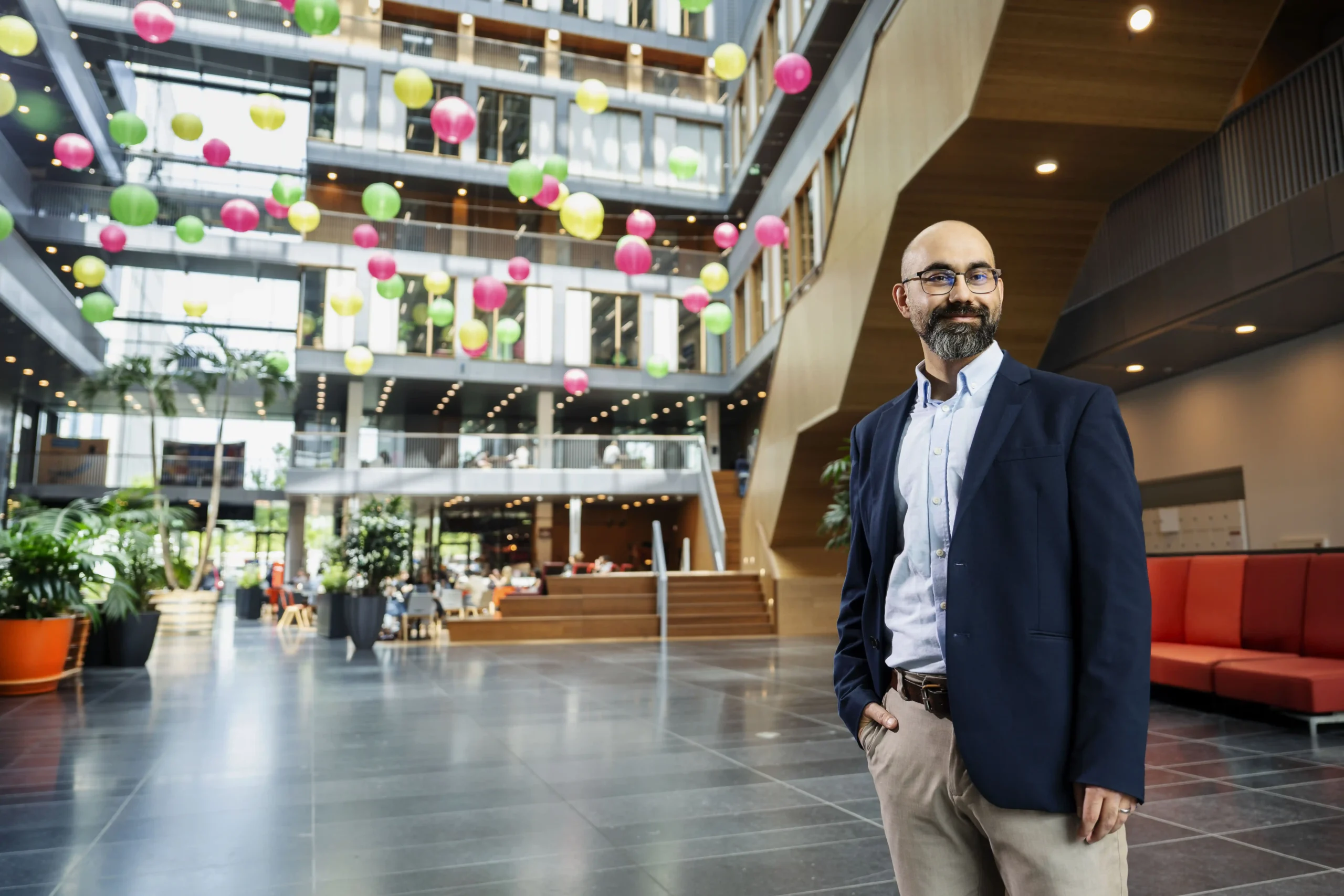
Yusuf Çelik (1986) — Vrije Universiteit Amsterdam
‘Religious communities have influenced each other in many different ways’
In an era rife with polarisation, it may be difficult to imagine, but the course of history has been marked by frequent dialogue, friendship and love between people of different religions. There is clear evidence of these interactions: religions have adopted all sorts of ideas and customs from each other. Yusuf Çelik, assistant professor of Digital Humanities and Islam at VU University Amsterdam, studies exactly how this cross-pollination took place. To that end, he is searching through vast quantities of old texts with the aid of artificial intelligence.
Lees dit interview in het Nederlands (NewScientist)
Friendship and destruction
Sometimes Çelik stumbles upon a beautiful story about the friendship between a Jewish councillor and an Islamic sultan, and at other times he reads about friction and tensions between Jews and Muslims. ‘I hope that through my work, I can demonstrate that history encompasses both aspects,’ he says. ‘I don’t want to gloss over the conflict, but I do want to give equal weight to the other aspects of history.’
By studying these kinds of stories, Çelik hopes to gain insight into how people thought and felt in the past. For example, he has studied how love between people of different religions was viewed. ‘There is a legend about a Christian woman and a Muslim man who fall in love and are willing to break their own traditions for each other,’ he tells us. ‘I saw that there were big differences in how people received and interpreted the legend. One group saw it as undesirable, while the other saw it as something very noble and beautiful.’
Political discussions can also provide valuable insight into how people thought. ‘After a synagogue was damaged under unknown circumstances in 1475, Sultan Qaitbay consulted scholars on whether he should restore it,’ says Çelik. ‘Two scholars told him: no, that is not our responsibility. Others urged him to do it. I still want to find out more about the motivation of these different scholars. Did the proponents want to restore the synagogue out of compassion? Or out of a sense of justice? And what drove the opponents? Was it a kind of religious fanaticism?’ An interesting detail: Çelik discovered that the opponents wrote satirical poems about the discussion. ‘You might say that they let loose on the social media of their time.’
Unexpected corners
The use of artificial intelligence opens up a whole range of new possibilities in Çelik’s research. ‘The texts from the large library of Islamic literature that we currently have available in digital formats amount to about 1.5 billion words. If I had to go through them all one by one, it would take me several lifetimes.’ Thanks to AI, Çelik is able to quickly detect interesting things that are sometimes found in the most unexpected places. ‘For example, a document on botany might contain an anecdote about a Jewish-Islamic friendship.’
‘Digitally searching texts for words such as ‘Jew’ or ‘Muslim’ has been possible for some time now. However, AI can also identify text fragments that do not contain that specific word, but are still related to the topic. For example, if you search for ‘hypocrites’, AI can also recognise fragments that are about ‘charlatans’. In the future, we may be able to take it a step further: searching for a topic based not on specific words, but on the meaning of the text as a whole.’
In short: AI opens up all kinds of possibilities for re-examining history. Çelik has lots of plans for the future. ‘For instance, I want to look for stories in which people describe their dreams. Did they dream of camels, or were their dreams occupied with palaces and riches? I would also like to delve into the history of heartbreak. How did people experience that back then?’
Film series
There is still much to discover about the cross-pollination between different religions, such as Islam and Judaism. ‘When Islam spread to areas where Jewish people lived in the 8th and 9th centuries, dialogue emerged,’ says Çelik. ‘The Koran could actually be viewed as the third part of a film series. All sorts of characters were introduced, such as Joseph, Abraham, David and Jesus. But the Koran did not always provide context about who these people were and what certain things referred to. The Jews had seen films 1 and 2 and could say: in this section, the Koran is referring to an event that is also recorded in our own writings.’
This sparked conversations between Muslims and Jews. Some Jews also converted to Islam. ‘These converts enjoyed a lot of respect in the new community,’ Çelik explains. ‘This is because they brought knowledge and experiences that other Muslims did not have. The irony is that Muslims then incorporated this knowledge into their own books. That dialogue died out as a result.’ And the exchange went both ways. ‘Muslims told certain stories about Abraham,’ says Çelik. ‘Jews found these stories about their own patriarch so fascinating that they adopted them and passed them on in their own narratives.’
Çelik would like to see more acknowledgement of this cross-pollination. ‘I would like to contribute to people getting to know their own history more deeply, in all of its layers and diversity. And to realise that we adopt certain things from each other, even if we don’t always realise it. I am Muslim myself, and I have reservations about working on Sundays, for example. That does not come from Islam. In fact, Islam has no objection at all to working on Sundays. But because I grew up in the Netherlands, I have adopted the Christian attitude towards Sundays.’
‘We are all connected, and I hope that a generation will come that recognises and appreciates that. If I show evidence that people in the past also saw and appreciated that connection, people today might think: Oh, so I can just be Muslim and still appreciate these things in my own, maybe atypical way? Yes, you can.’
Video
Young Scientist – Yusuf Çelik